Skill Paths
Skill Paths are curated, ultra-focused sequences of learning materials built around a single practical skill.
The server-side domain is vast, and trying to study it end-to-end is nearly impossible. A more effective strategy is to accept that comprehensive mastery isn't practical and instead acquire one hands-on skill at a time. That's exactly what a Skill Path is for.
Where a Course walks you through a whole subject in a strict, gated sequence, a Skill Path is a lighter, more flexible collection - a hand-picked list of Challenges, Tutorials, and technical diagrams that together build up one specific competency, like controlling process resources with cgroups, building container images, or getting started with Dagger.
What a Skill Path looks like
A Skill Path is a curated list of existing learning materials, grouped around a theme.
Instead of introducing a new content format, a Skill Path assembles materials you already know into a focused track:
- Challenges to practice the skill hands-on
- Tutorials and standalone Courses Lessons to explain the concepts behind it
- Technical diagrams and references to tie the pieces together
The author picks and orders these so that, by working through the path, you develop or sharpen one well-defined skill rather than wandering across a broad topic.
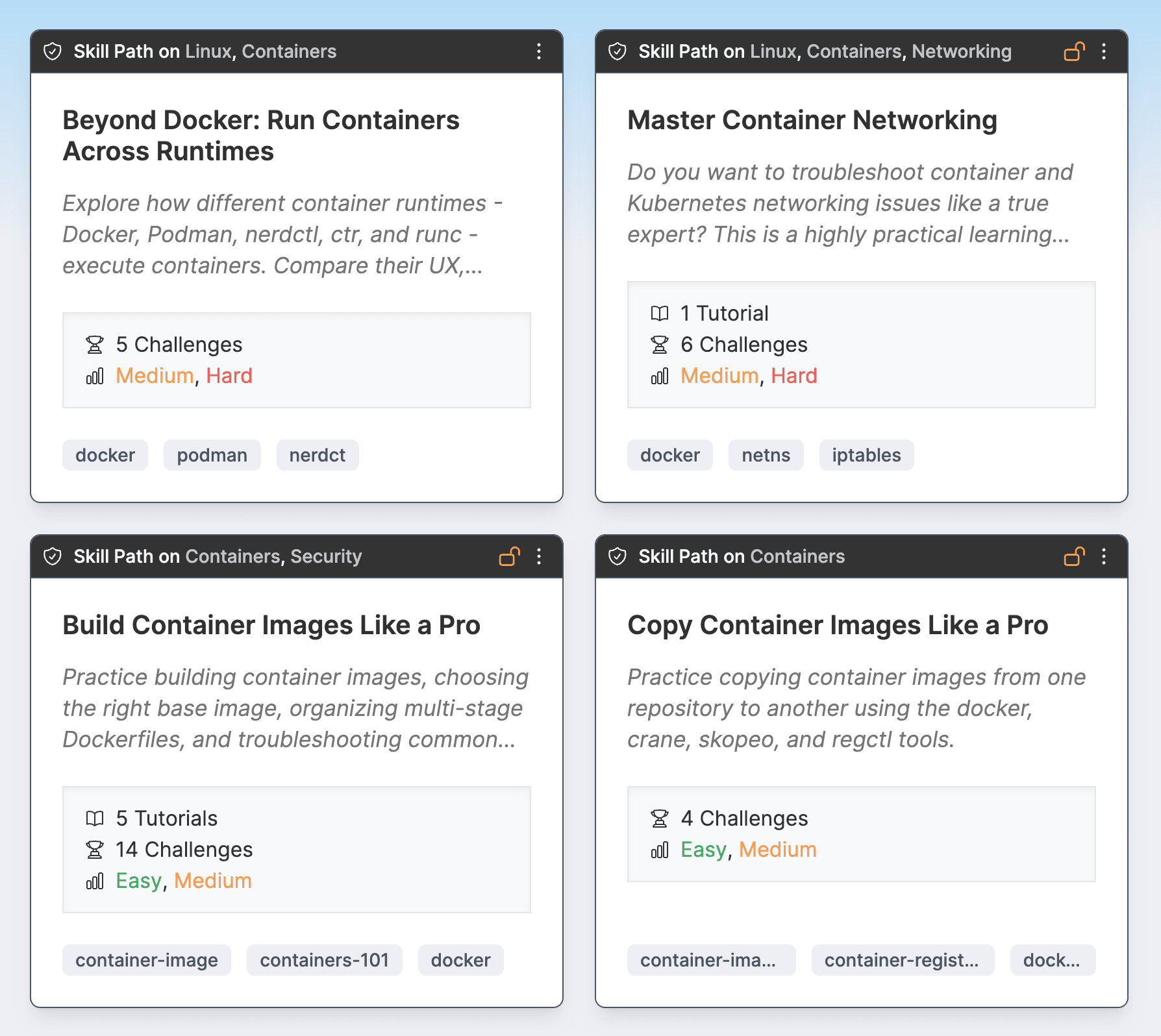
Browse the collection of Skill Paths and pick one to start building your skills.
Why Skill Paths are great
Skill Paths are designed to fit into a busy schedule and meet you at your current level:
- Ultra-focused - some can be completed in a day, most in under a week
- Flexible - filter by topic and difficulty to match where you are right now
- Trackable - follow your progress with helpful ✅ markers as you go
The whole point of a Skill Path is narrow scope: one skill, a short list of materials, and a clear finish line.
Starting and completing a Skill Path
Skill Paths are first-class, trackable units on the platform.
You can start following a Skill Path, and as you complete its individual units - solving the linked Challenges and reading the Tutorials - your progress is recorded. When every unit is done, you can mark the whole path as completed, with the result reflected in your personal dashboard.
To start a path and have your progress saved, you need to be signed in. The materials inside a path can usually be read like ordinary articles without an account.
How to approach Skill Paths
A Skill Path works best when you treat it as a short, deliberate sprint toward one skill.
You'll get the most out of it if you:
- Pick a path that targets a skill you actually want right now
- Work through the units in order rather than cherry-picking
- Do the Challenges hands-on instead of only reading the Tutorials
- Finish it - a completed path is a concrete, trackable win
As with Challenges and Tutorials, the learning happens in the doing. Working through the materials yourself is the entire point of a Skill Path.
When to use Skill Paths
Reach for a Skill Path when you want to:
- Build or sharpen one specific, practical skill
- Make visible progress quickly, in days rather than weeks
- Follow a curated short list instead of assembling materials yourself
- Focus, rather than commit to a full Course
If you find yourself wanting broader, deeper coverage of a whole subject, a Course is the better fit. If you want to go even wider, a Roadmap ties many skills together into a comprehensive journey.
Skill Paths, Courses, and Roadmaps
Skill Paths are one of several ways to follow a structured path through iximiuz Labs materials.
Skill Paths are short, focused sequences built around a single skill, assembled from existing Challenges, Tutorials, and diagrams.
Courses combine Tutorial-like Lessons and Challenges into a deeper, gated curriculum for a whole subject.
Roadmaps are the most comprehensive format - large, hands-on journeys that take you from zero to proficient across an entire domain like Linux, Docker, or Kubernetes.
Where to start
Explore the collection of Skill Paths and pick one that targets a skill you want next.
Filter by topic and difficulty to find a path that matches your current level, then start it and work through the units one by one. Because most paths are short, finishing one is a quick, satisfying way to build momentum before moving on to the next.