Will It Help Me Improve Cloud Skills?
Based on our experience and hearing back from hundreds of engineers who actually achieved their learning goals, a sequence that has traditionally led to the most solid understanding and the most transferable knowledge is:
Linux → Networking → Containers → Kubernetes → Cloud
Jumping straight into learning the higher-level components, such as AWS VPC, Security Groups, Internet Gateways, or even Kubernetes, is not uncommon, but it often results in longer mastering time and the need to "re-learn" from scratch after switching from AWS to Azure or from Kubernetes to Nomad or AWS ECS.
In contrast, when you first learn about LANs (L2 broadcast domains, typical switch topologies, etc.), then L3 routing, firewalling with iptables, and establishing connectivity to the outside world with NAT, understanding what VPC and Security Group actually are becomes much easier.
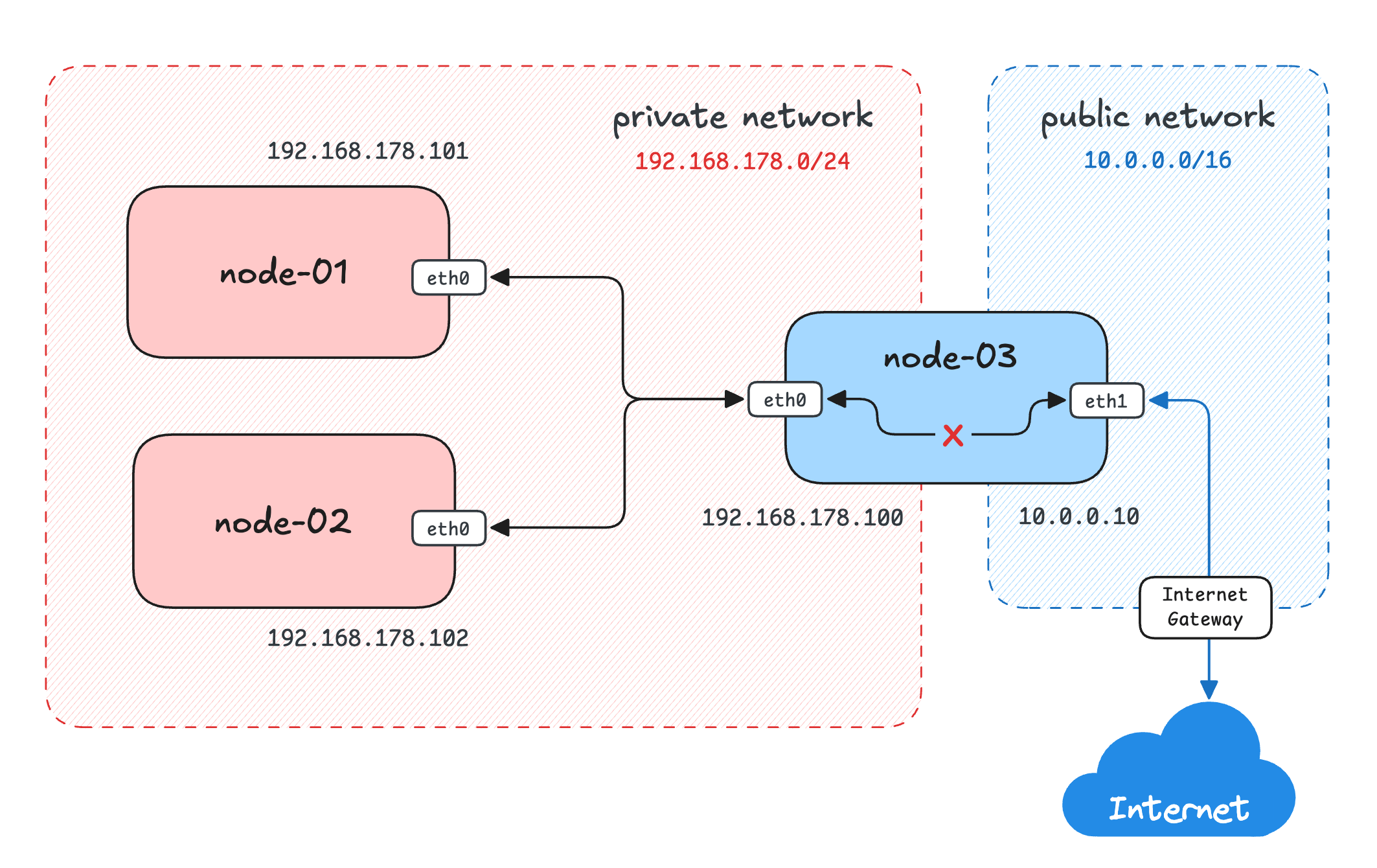
Problem: Enable Internet Access for a Private Network with a NAT Gateway
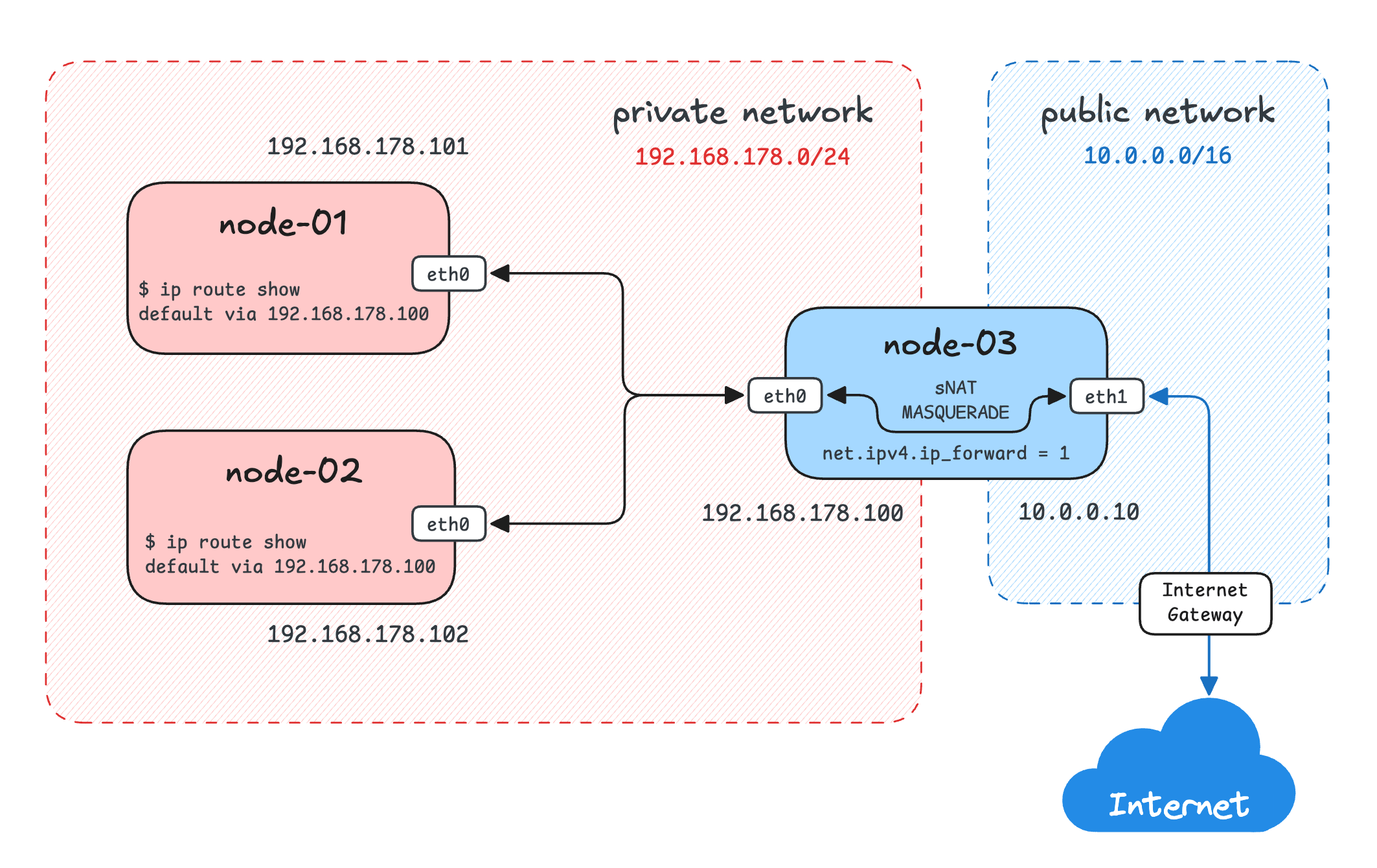
Solution: Enable Internet Access for a Private Network with a NAT Gateway
One more good thing about this approach is that focusing on fundamentals makes the knowledge transferable sideways, too.
For instance, container networking (Docker's typical bridge network) and Kubernetes' Node and Pod networking rely on the same L2 broadcast domain, L3 routing, and iptables concepts from above, even if some of the primitives will be virtualized (e.g., a Linux bridge is a virtual switch and a network namespace is an analog of an isolated network node).
This is why at iximiuz Labs, we focus on the fundamentals of the server-side tech.
- Previous
- What is iximiuz Labs