What Is a Standard Container: Diving Into the OCI Runtime Spec

TL;DR Per the OCI Runtime Specification:
- Containers are isolated and restricted boxes for running processes 📦
- Containers pack an app and all its dependencies (including OS libs) together
- Containers are for portability - any compliant runtime can run a standard
imagebundle - Containers can be implemented using Linux, Windows, and other OS-es
- Virtual Machines also can be used as standard (i.e., OCI-compliant) containers 🤐
There are many ways to create containers, especially on Linux. Besides the super widespread Docker implementation, you may have heard about LXC, Incus, systemd-nspawn, or maybe even OpenVZ.
The general concept of the container is quite vague. What's true and what's not often depends on the context, but the context itself isn't always given explicitly. For instance, there is a common saying that containers are Linux processes or that containers aren't Virtual Machines. However, the first statement is just an oversimplified attempt to explain Linux containers. And the second statement simply isn't always true.
In this article, I'm not trying to review all possible ways of creating containers. Instead, the article is an analysis of the OCI Runtime Specification. The spec turned out to be an insightful read! For instance, it gives a definition of the standard container (and no, it's not a process) and sheds some light on when Virtual Machines can be considered containers.
The form of containers Docker brought later became a standard (OCI), and most modern container runtime implementations are OCI-compliant. Today we even use the terms container, Docker container, and Linux container interchangeably. However, this is just one type of OCI-compliant container. So, let's take a closer look at the OCI Runtime Specification.
What is Open Container Initiative (OCI)
Open Container Initiative (OCI) is an open governance structure that was established in 2015 by Docker and other prominent players of the container industry to express the purpose of creating open industry standards around container formats and runtimes. In other words, OCI develops specifications for standards on Operating System process and application containers.
Do you also find so many fancy words overwhelming for such a short paragraph?
Here is how I understand it. By 2015 Docker already gained quite some popularity, but there were other competing projects implementing their own containers like rkt and lmctfy. Apparently, the OCI was established to standardize the way of doing containers. De facto, it made the Docker's container implementation a standard one, but some non-Docker parts were incorporated too.
What is an OCI Container
So, how does OCI define a Container nowadays?
A Standard Container is an environment for executing processes with configurable isolation and resource limitations.
Why do we even need containers?
[To] define a unit of software delivery ... The goal of a Standard Container is to encapsulate a software component and all its dependencies in a format that is self-describing and portable, so that any compliant runtime can run it without extra dependencies, regardless of the underlying machine and the contents of the container.
Ok, and what can we do with containers?
[Containers] can be created, started, and stopped using standard container tools; copied and snapshotted using standard filesystem tools; and downloaded and uploaded using standard network tools.
![[object Object]](/content/files/tutorials/oci-containers-explained/__static__/container-portability.png?v=1778165817645)
Operations on containers that OCI runtimes must support: Create, Start, Kill, Delete, and Query State.
Well, makes sense. But... a container cannot be a process then!
According to the OCI Runtime Spec, a container is an isolated and restricted environment for running one or more processes.
Learn by doing, not just by reading or watching
Sign up for a free account to start a VM playground right on this page, track your progress, and get notified about new learning materials.
Linux Container vs. Other Containers
Apart from the container's operations and lifecycle, the OCI Runtime Spec also specifies the container's configuration and execution environment.
Per the OCI Runtime Spec, to create a container, one needs to provide a runtime with a so-called filesystem bundle that consists of a mandatory config.json file and an optional folder holding the future container's root filesystem.
A bundle is usually obtained by unpacking a container image, but images aren't part of the Runtime Spec. Instead, they are defined in a dedicated OCI Image Specification.
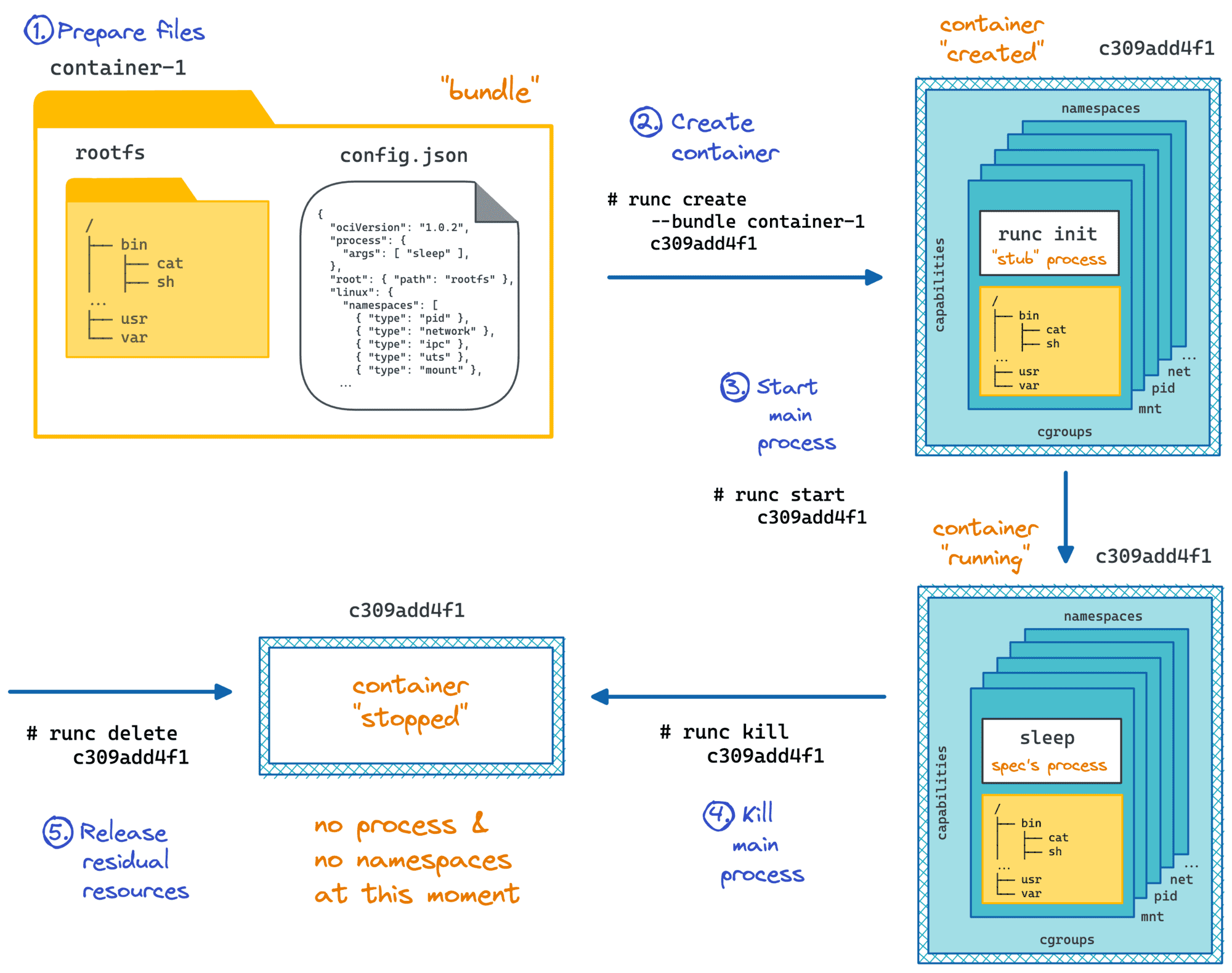
The config.json file contains data necessary to implement standard operations against the container (Create, Start, Query State, Kill, and Delete). But things start getting really interesting when it comes to the actual structure of the config.json file.
The configuration consists of the common and platform-specific sections. The common section includes ociVersion, root filesystem path within the bundle, additional mounts beyond the root, a process to start in the container, a user, and a hostname.
Hmm... but where are the famous namespaces and cgroups?
At the time of writing this article, the OCI Runtime Spec defines containers for the following platforms: Linux, FreeBSD, Solaris, Windows, z/OS, and Virtual Machine.
Wait, what?! VMs are Containers??! 🤯
In particular, the Linux-specific section brings in (among other things) pid, network, mount, ipc, uts, and user namespaces, control groups, and seccomp. In contrast, the Windows-specific section comes with its own isolation and restriction mechanisms provided by the Windows Host Compute Service (HCS).
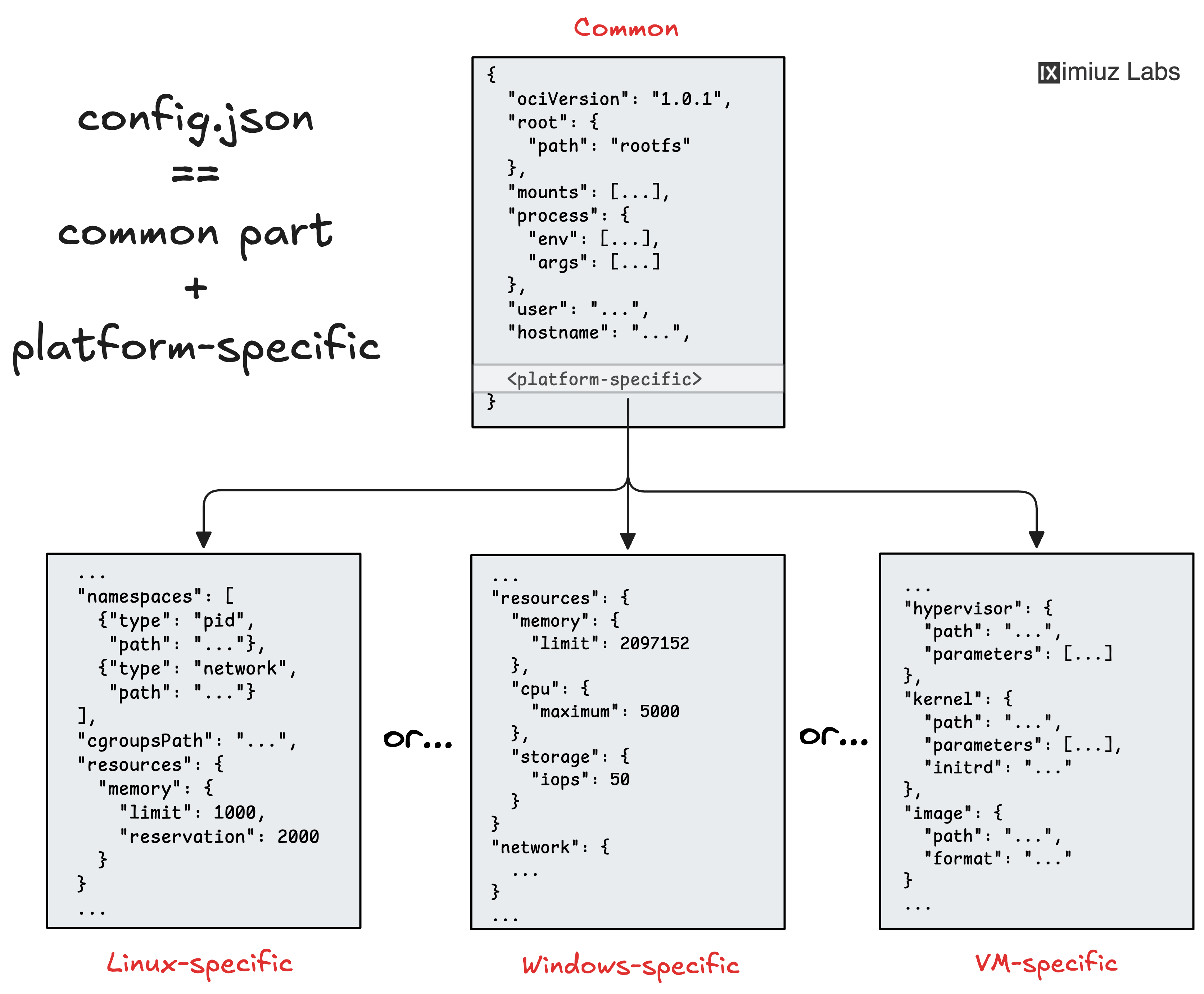
The OCI Runtime Specification's config.json file consists of the common and platform-specific parts.
Thus, only Linux containers rely on namespaces and cgroups.
However, not all standard (i.e., OCI-compliant) containers are Linux containers.
Virtual Machines vs. Containers
The most widely-used OCI runtimes are runc and crun. Unsurprisingly, both implement Linux containers. But as we just saw, the OCI Runtime Spec mentions Windows, FreeBSD, Solaris, and other containers. And what's even more intriguing, it defines VM-based containers.
Aren't containers were meant to replace VMs as a more lightweight implementation of the same execution environment abstraction?
Let's take a closer look at VM containers.
Clearly, they are not backed by Linux namespaces and cgroups. Instead, the Virtual-machine-specific Container Configuration mentions a hypervisor, a kernel, and a VM image. So, the isolation is achieved by virtualizing the hardware (via a hypervisor) and then booting a full-fledged OS (a separate kernel + a VM image) on top of it. The resulting environment is our box, i.e., a container.
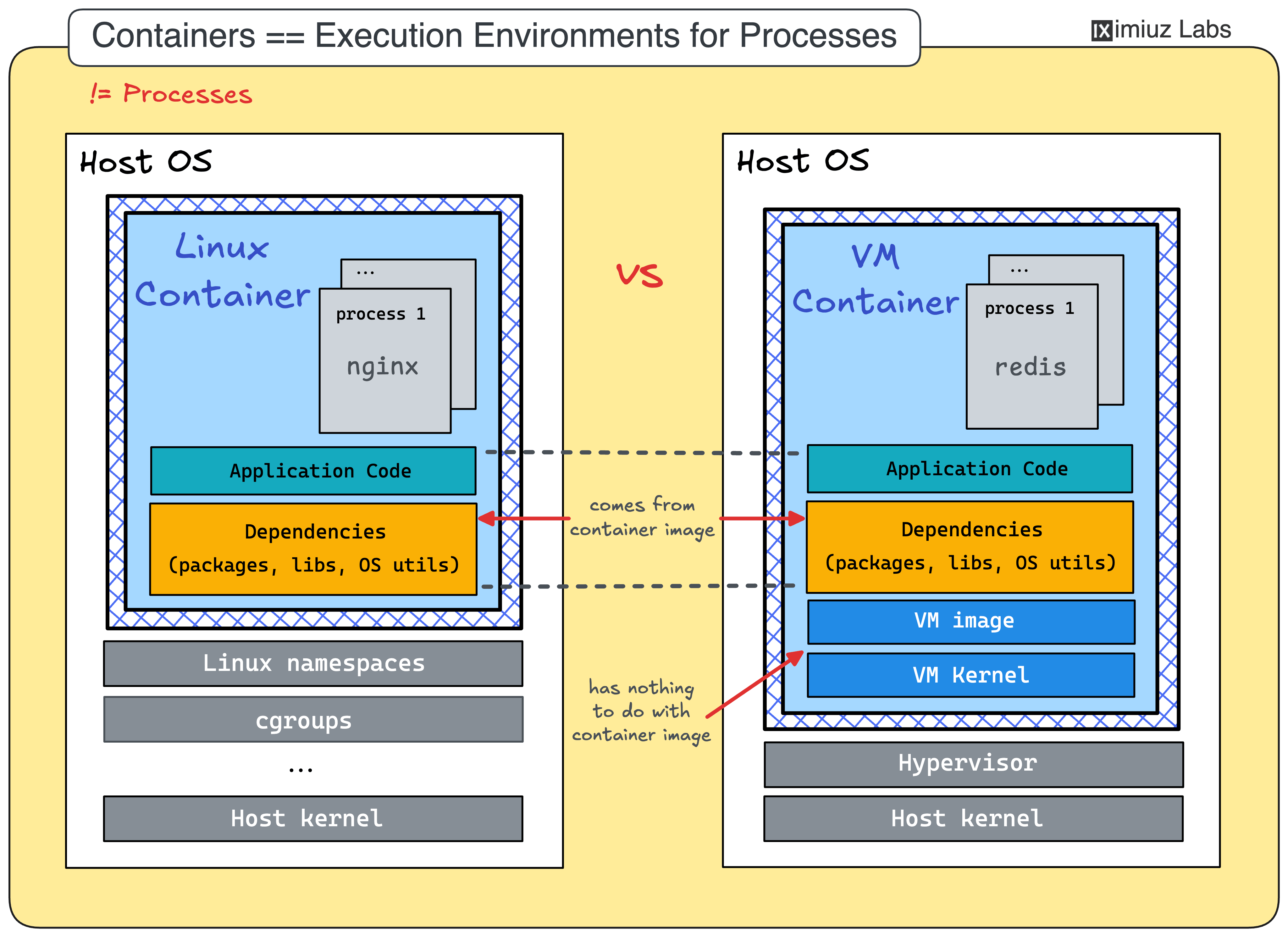
Notice that the VM image mentioned by the OCI Runtime Spec has nothing to do with regular container images that are used to create a bundle. The bundle's root filesystem is mounted into a VM container separately.
Thus, VM-based containers are a thing!
The OCI Runtime Spec even lists a few projects that implement VM-based containers. However, only one of these projects is not deprecated (at the time of writing this) - Kata Containers. And the "good old" Linux containers still remain the default choice in production.
MicroVMs vs. Containers
One of the main "selling points" of Linux containers is/was that they are much more lightweight than Virtual Machines. The startup time is under a second, and there is almost no space and runtime overhead. However, their strongest part is their weakness as well. Linux containers are so fast because they are regular processes. So, they are as secure as the underlying Linux host. Thus, Linux containers are only good for trusted workloads.
Since shared infrastructure (a.k.a., Cloud) is common nowadays, the need for stronger isolation remains. Serverless/FaaS computing is probably one of the most prominent examples. By running code in AWS Lambda or a similar FaaS platform, you just don't deal with the server abstraction anymore. Hence, there is no need for virtual machines or even containers for development teams. But from the platform provider standpoint, using Linux containers to run workloads of different customers on the same host would be a security nightmare. Instead, functions need to be run in something as lightweight as Linux containers and as secure as Virtual Machines.
AWS Firecracker to the rescue!
The main component of Firecracker is a virtual machine monitor (VMM) that uses the Linux Kernel Virtual Machine (KVM) to create and run microVMs. Firecracker has a minimalist design. It excludes unnecessary devices and guest-facing functionality to reduce the memory footprint and attack surface area of each microVM. This improves security, decreases the startup time, and increases hardware utilization. Firecracker has also been integrated in container runtimes, for example Kata Containers and Weaveworks Ignite.
While serverless workloads were the original motivation for Firecracker, it's now used in a wider range of use cases, including Agent Sandboxing.
But Firecracker is not an OCI-compliant runtime on itself... It's a regular VMM that runs (micro)VMs. However, it's always possible to launch an OCI runtime (e.g., runc) inside a Firecracker (micro)VM, which gives you the best of both worlds - portability of containers, lightness of microVMs, and full isolation from the host operating system. In particular, Kata Containers can use Firecracker as one of its supported VMMs, and the firecracker-containerd project allows containerd to run OCI containers as Firecracker microVMs.
Check out this awesome diagram that shows how Kata Containers uses Firecracker to run OCI containers "wrapped" into microVMs.
Another interesting project in the area of secure containers is Google's gVisor:
gVisor is an application kernel, written in Go, that implements a substantial portion of the Linux system surface. It includes an Open Container Initiative (OCI) runtime called runsc that provides an isolation boundary between the application and the host kernel. The runsc runtime integrates with Docker and Kubernetes, making it simple to run sandboxed containers.
Unlike Firecracker, gVisor is an OCI-complaint runtime. But gVisor is not a full-fledged hypervisor (like KVM). It emulates the kernel in the user-space, which is pretty cool, but the runtime overhead and compatibility issues are real.
Summarizing
To summarize, containers aren't just slightly more isolated and restricted Linux processes. Instead, they are standardized execution environments improving workload portability. Linux containers are the most widespread form of containers nowadays, but the need for more secure containers is growing. The OCI Runtime Specification defines VM-backed containers, and Kata Containers makes them real. It's an exciting time to explore the containerverse!
Practice
The best way to actually see what containers are (and are not) is to try running a few of them using different runtimes.
About the Author

Ivan Velichko
Ivan is the creator of iximiuz Labs and a long-time tech blogger and educator with a traditional focus on server-side tech and containers.
Writes about
Frequently covers
More tutorials you might like
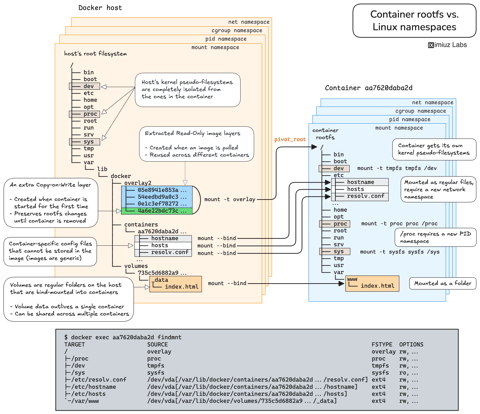
How Container Filesystem Works: Building a Docker-like Container From Scratch
Learn how Linux containers are built from the ground up. Starting with the mount namespace and a root filesystem, see why PID, cgroup, UTS, and network namespaces naturally follow - and how this foundation makes concepts like bind mounts, volumes, and persistence in Docker or Kubernetes much easier to grasp.
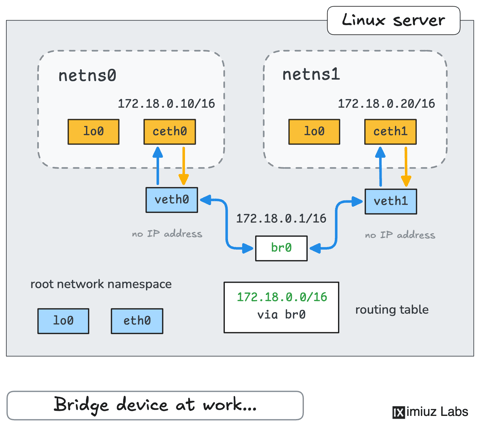
How Container Networking Works: Building a Bridge Network From Scratch
Begin with the basics to understand Docker and Kubernetes networking: learn how to create and interconnect Linux network namespaces using only command-line tools.
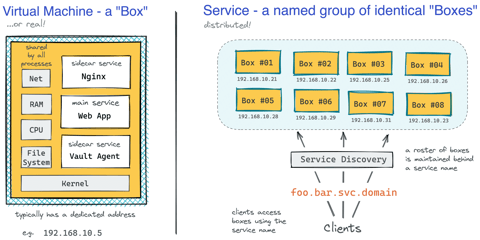
How Kubernetes Reinvented Virtual Machines - In a Good Sense
How Virtual Machines were used to deploy services. What old problems containers solve and what new problems create. How Kubernetes used containers to recreate Virtual Machines in a better way?
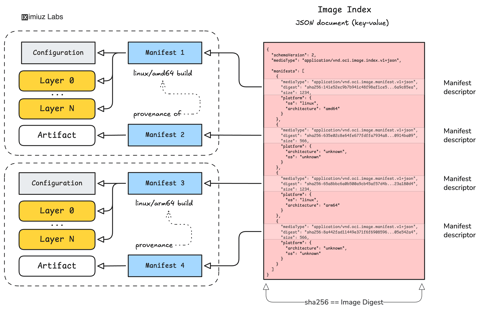
How Container Images Actually Work: Layers, Configs, Manifests, Indexes, and More
A practical deep dive into container image internals that will help you build a clear mental model of how images are composed, identified, stored, and distributed across registries.
Learn by doing, not just by reading or watching
Sign up for a free account to start a VM playground right on this page, track your progress, and get notified about new learning materials.