Create a Process from Scratch Using Syscalls

In Linux, userspace processes cannot be created out of thin air. Process creation is performed using low-level system calls: fork() (which clones the calling process) and execve() (which replaces the process memory layout with a new executable program from disk).
When fork() is called, it returns twice: it returns 0 inside the newly created child process, and returns the numeric Process ID (PID) of the child to the parent process.
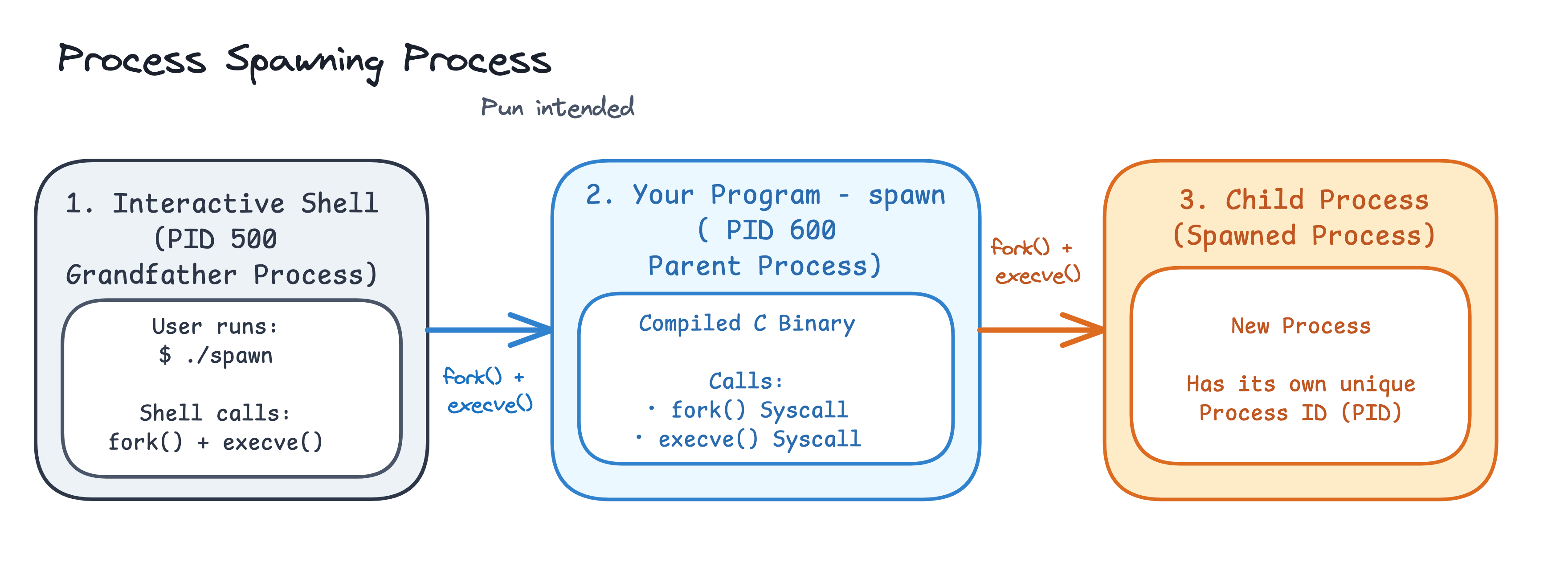
Overview of execution flow: bash spawns ./spawn, which in turn calls fork() and execve() to spawn a child process.
In this challenge, you will put process creation primitives into practice by writing a C program that calls fork() and execve(), compiles it with gcc, and retrieves the child PID.
Your task is to:
- Create a workspace directory named
~/exerciseand navigate into it (mkdir -p ~/exercise && cd ~/exercise). - Write a C program in
~/exercise(e.g.,spawn.c) that spawns a child process usingfork()andexecve(), and prints the child process PID to standard output. - Compile your C program using
gccinto an executable binary inside~/exercise. - Run your compiled binary and enter the numeric Process ID (PID) of the spawned child process.
Hint 1: Required C Header Libraries
Include the necessary C standard headers for process handling:
#include <stdio.h>
#include <stdlib.h>
#include <unistd.h>
#include <sys/types.h>
#include <sys/wait.h>
Hint 2: Understanding fork() Return Values
fork() returns twice:
- In the parent process,
fork()returns the PID of the newly created child (a positive integer). - In the child process,
fork()returns0.
#include <stdio.h>
#include <unistd.h>

int main(void) {
    pid_t pid = fork();
    if (pid == 0) {
        // Child process
    } else if (pid > 0) {
        printf("Child PID: %d\n", pid);
    }
    return 0;
}
Hint 3: Compiling and Running
Compile and execute your program inside ~/exercise:
gcc spawn.c -o spawn
./spawn